 Home
| Stories
| Oracle and Canon
Home
| Stories
| Oracle and Canon
Oracle and Canon
 wo ancient modes of mind meet at the heart of this piece:
improvisation and pre-planning. From a handful of randomly drawn notes, a
spontaneous musical Oracle is created — unrepeatable, alive in this moment.
From that same seed, a carefully constructed Musical Canon (a type of
"round") takes shape, precise and inevitable. Inspiration and architecture.
Moon and sun. Intuition and intellect. This is a
wo ancient modes of mind meet at the heart of this piece:
improvisation and pre-planning. From a handful of randomly drawn notes, a
spontaneous musical Oracle is created — unrepeatable, alive in this moment.
From that same seed, a carefully constructed Musical Canon (a type of
"round") takes shape, precise and inevitable. Inspiration and architecture.
Moon and sun. Intuition and intellect. This is a
meditation in sound on
how we meet the cards life deals us — and how we choose to
respond.
Musical Oracle
Much of Life comes down to this:
we’re dealt cards
we didn’t choose —
opportunities, setbacks, surprises…
all the things
Life throws at us.
Sometimes we like the hand we’re dealt;
other times —
not so much.
But our freedom — our human agency —
lies in how we play those
cards,
how we respond.
It occurred to me:
what if I made music that same way?
What if I let
myself be dealt some notes I didn’t choose,
and then shaped them —
spontaneously —
into a piece of music?
So I made a card deck.
Not a Tarot deck, not a poker deck…
a music
deck.
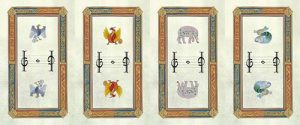
Twelve cards
for the twelve notes
of the chromatic scale.
And since card decks usually come with four suits,
I figured, sure — let’s
do hat, too.
Because… why not?
And let’s name them using the ancient elements:
earth, air, fire, and
water.
Because… why not?
And let’s represent each suit with an animal.
Because… why not?
Eagle for air.
Dragon for fire.
Elephant for earth.
Fish for water.
I don’t know what deep purpose the suits might serve.
But at the very
least,
they let a note show up more than once.
Beyond that… we’ll see.
So in the end,
twelve notes times four suits
gives us forty-eight cards
total.
Meanwhile, the point of all this
is the ritual.
I shuffle the
deck,
draw some cards,
and whatever notes appear
become the seed of
an improvisation.
No prep,
no pre-compose and polish.
Just a spontaneous musical
response
to whatever the oracle deals to me.
And since I’m recording these improvisations,
each one needs a title.
And in the spirit of this ritual,
I figured the title should be random
too.
So I built a little song-title generator —
a fun bit of software
that
picks a noun
and one or two adjectives.
It comes up with titles like
Lavender Mystic Fragment
or Lilac
Sanctified Vigil.
I designed it with hundreds of thousands of possible titles,
which should
keep me busy for a while!
I’ve put the link to it in the
description
so you can play with it too if you want.
I call this whole thing
the Musical Oracle.
In ancient times,
an oracle was a place
where randomness met meaning —
where a chance event
became a message,
a clue,
a path.
Part of the inspiration
comes from the Zen calligraphers.
They would
center themselves,
take one breath,
and make a single brushstroke —
no hesitation,
no correcting,
no polishing.
The point wasn’t perfection,
but a moment of genuine presence.
I’m nowhere near their league, of course,
but I’m drawn to the
spirit
of what they were doing.
They weren’t trying to put on a show.
They were trying to meet the present
honestly,
with whatever they had
right in that moment.
This ritual
aspires to something like that.
The oracle gives me some
notes;
and I respond musically.
It’s simple,
it’s fun,
and for
me
it’s a lovely metaphor
for the ongoing dance we all have
with
the randomness life hands us…
and the way we choose
to answer it.
Musical Canon
One response to life’s slings and arrows
is
spontaneous reaction and response.
Another is to step back
and deeply plan
our course of action.
If the Oracle lives at the spontaneous end of the creative spectrum,
then
at the opposite end we find music that is meticulously pre-planned —
designed from the inside out.
One of the oldest ways of doing that
is the canon —
a kind of musical
sudoku
that composers have explored since the Renaissance.
A well-known type of canon is the round —
like Row, Row, Row Your Boat —
where a single melody is designed
to fold onto itself
and become a
complete piece.
In a way, it’s musical DNA:
a tiny blueprint
that already contains the
logic
of an entire living piece of music.
Once set in motion,
the
piece unfolds from that seed
into its full form.
So while the Oracle is essentially unrepeatable,
the Canon unfolds through
repetition
from its musical DNA.
Another way to look at this
is through how our brains work.
Two
hemispheres,
each with its own gifts.
The right concerned with intuition.
The left concerned with
intellect.
And in practice,
the two are always dancing —
sometimes
the right leads,
sometimes the left.
In an Oracle,
the right hemisphere leads.
In a Canon,
the left does.
We’ve just had an Oracle
based on our randomly given musical fragment.
Now —
here is a Canon
constructed from that same fragment.
First, I’ll play the musical DNA by itself —
just once.
Then I’ll let it unfold
into its complete round form.
—William Zeitler
2025 December 5

You’re reading GrailHeart — devoted to what is best about being human.